
Crypto isn't forex, and leverage is how new traders find out
I keep watching new crypto traders make the same mistake. Here's what it is, and what the survivors do differently.
بقلم مكتب ديريف · 22 أكتوبر 2026 · 7 دقيقة للقراءة

The most common way I see a new crypto trader lose money isn't a bad call. It's a good call in a position too big for the account to survive the ride.
This piece is about why that keeps happening, why crypto makes it so easy, and what I've noticed about the traders who are still here after a couple of market cycles.
The trade they were right about
Two definitions first, because the rest depends on them. Margin is the part of your account set aside to hold a position open. Liquidation is when the platform closes that position automatically because your losses have used up the money backing it. Where exactly that happens depends on the platform and the trade.
Here is the pattern. Someone watches crypto move 10% in a day and thinks, great, I'll put most of my account behind that. What they forget is that the move goes both ways. The market pulls back 15% on a Tuesday (which in crypto is just called Tuesday), and the position is closed before the trade they were right about ever plays out.
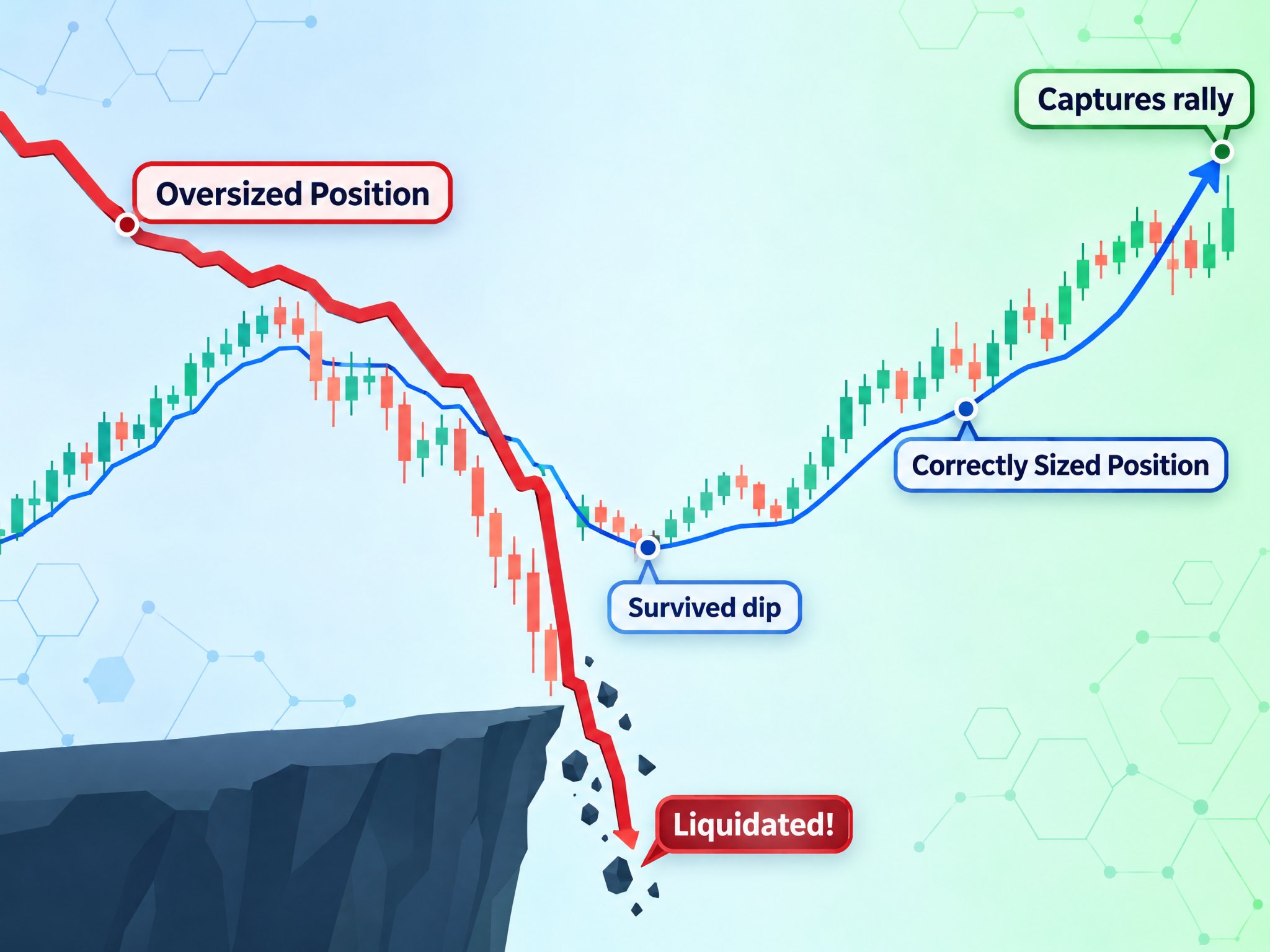
We see this on the desk fairly regularly. A client has $1,000 in the account, calls Bitcoin (BTC) right, and opens a position that uses nearly all of it as margin. Price drops about 4% over a couple of hours, then recovers and rallies 15% over the next week. They never see the rally, because with almost nothing left in the account to absorb the move, a 4% dip was enough to close them out. Same account, same trade, half the size, and they'd have sat through the dip and caught the rally. They were right about the market and lost a lot anyway.
That's what frustrates me. They're rarely wrong about direction. They're wrong about how far the market can move against them before it moves with them, and in crypto that number is bigger than most people's gut says. They haven't been bad at analysis. They've seized for a market that behaves like forex, and crypto does not behave like forex.
The one thing you actually decide
The leverage on a symbol is often set by the platform, so it isn't really your call. What you decide is how much of your account you commit to one trade, and that determines how far the market can move before you're closed out. Say you've got $1,000 in the account, and the price of the asset moves 10% against you.
- Use $100 of it as margin, and that move costs you some of that $100. Annoying, but you're still in, with $900 of buffer.
- Use $500, and the same move is eating into half your account. Uncomfortable.
- Use all $1,000, and there's nothing left to absorb the move. The platform closes you out before you've had a chance to be right.
The market move is identical in all three. The only thing that changed is how much room you left yourself.
Three ways crypto isn't forex
I think about the differences in three parts, and they're all connected.
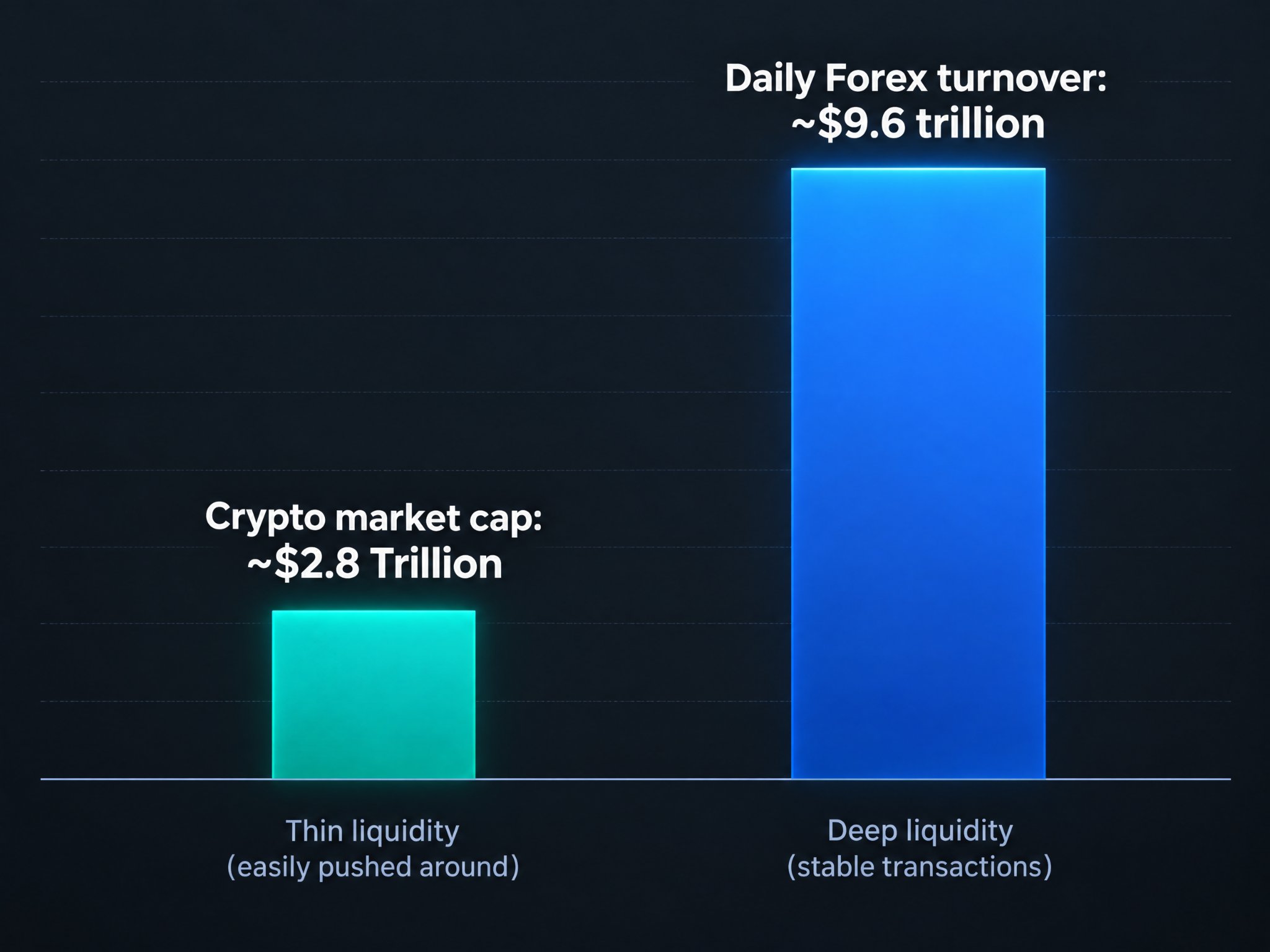
- Size. The whole crypto market, every coin added together, is worth around $2.8 trillion. Forex turns over about $9.6 trillion in a single day, according to the Bank for International Settlements' April 2025 survey. Those are different measures, total value against one day of trading, but the gap is the point. I read it two ways: crypto has a lot of room to grow, and it's thin enough to get pushed around easily.
- Liquidity. This is how easily you can buy or sell without moving the price, and in my view it dictates everything. In forex you can usually get out at roughly the price you expected. In crypto, when everyone heads for the exit at once, the exit gets very narrow very fast. That's why the pullbacks are so sharp. It isn't that the news is worse. It's that for a few minutes there's nobody on the other side of the trade.
- What you're trading. In forex you're trading, among other things, an economy's interest rate expectations. In crypto you're trading adoption of a technology, plus whatever social media is feeling that afternoon. Technical levels still matter. The fundamentals behind them are a completely different animal.
Who's still here after a couple of cycles
When I look at the traders who have lasted through more than one cycle, the same few habits keep showing up.
- They don't panic on a correction. A 20-30% pullback in crypto is normal, not a crisis, and the people who've been through one treat it as part of the furniture. Normal doesn't mean painless, though, and an oversized position may not make it through.
- They've taken the emotion out. I know that sounds like a cliché, but in crypto it matters more, because the market is designed to make you feel things. Green candles make you feel like a genius. Red candles make you feel like you should sell everything and move to a cabin. The traders who last have a plan written down before the candle shows up.
- They think in longer time horizons. That doesn't mean they never trade in and out. Plenty of them use futures to trade the sharp moves, and that's fine if it's your style. But the core view is measured in months and years, not in what happened since lunch.
- They're careful with position size. They know exactly what a 10% move does to a position that size, and they size accordingly.
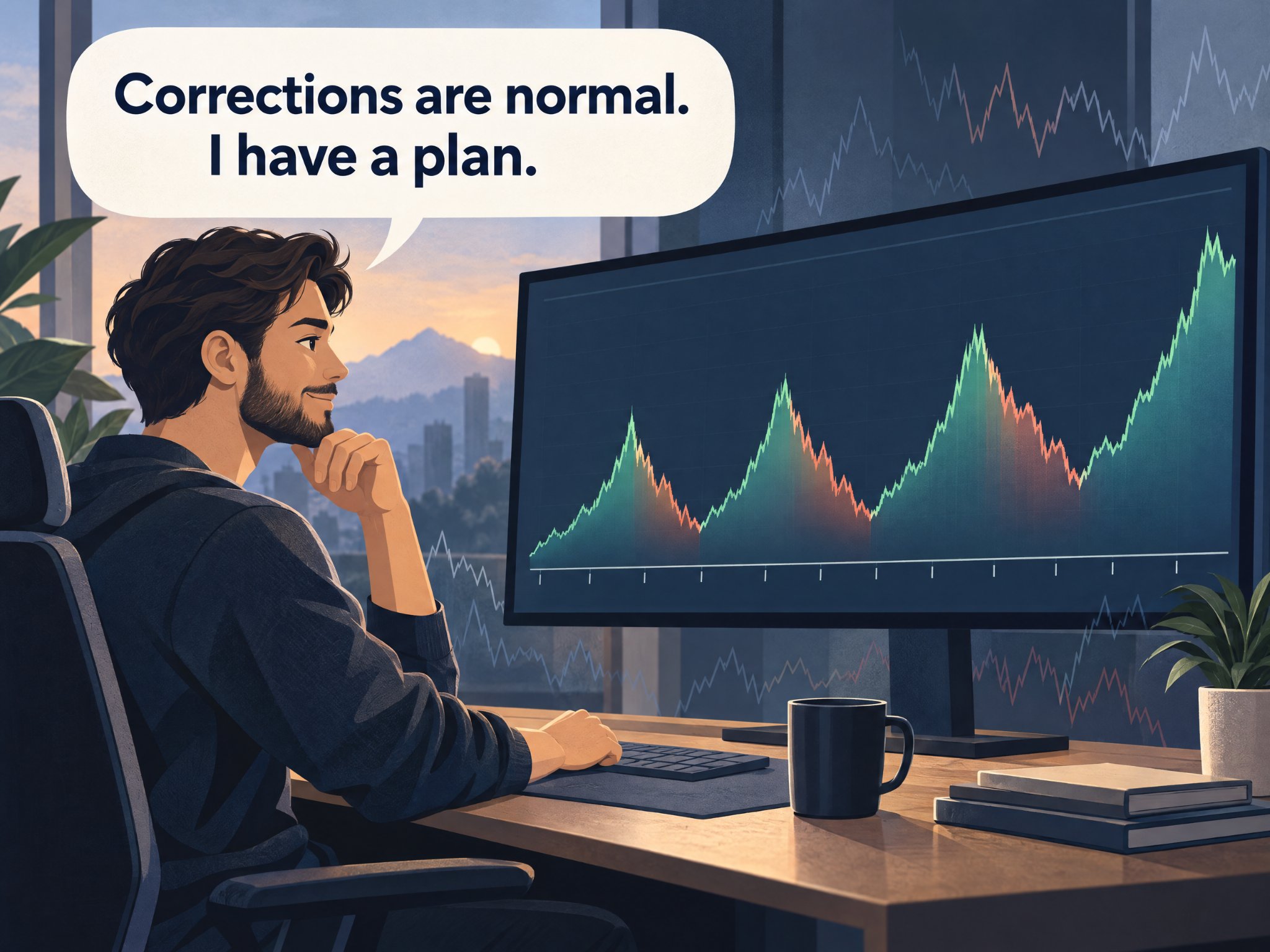
The ones who are still here didn't get there by being right every time. They got there by never being wiped out once.
What I'd do about a correction
Mostly it's done before the correction, not during.
- Know where the trade is wrong before you enter. If BTC goes below X, the idea's broken and I'm out. Write it down so you can't argue with yourself later.
- Size the position so you can actually follow that plan. If a 20% drop would either panic you or close you out before you reach your exit, the position was too big for the account.
- Don't add to a loser just because it's cheaper. Buying the dip is fine if you planned it. If you're deciding at 3am, it's not a plan.
- When the correction is actually happening, do less. Check whether anything that made you enter has changed. If not, leave it alone. Most of the damage in a correction comes from trades people put on in the middle of it.
Before a first trade
If someone asked me what to do before their first crypto trade, I'd start with this: do your own research. Genuinely. Not "a guy on YouTube said" research, but actual research into what the asset is, what it's for, and who's holding it.
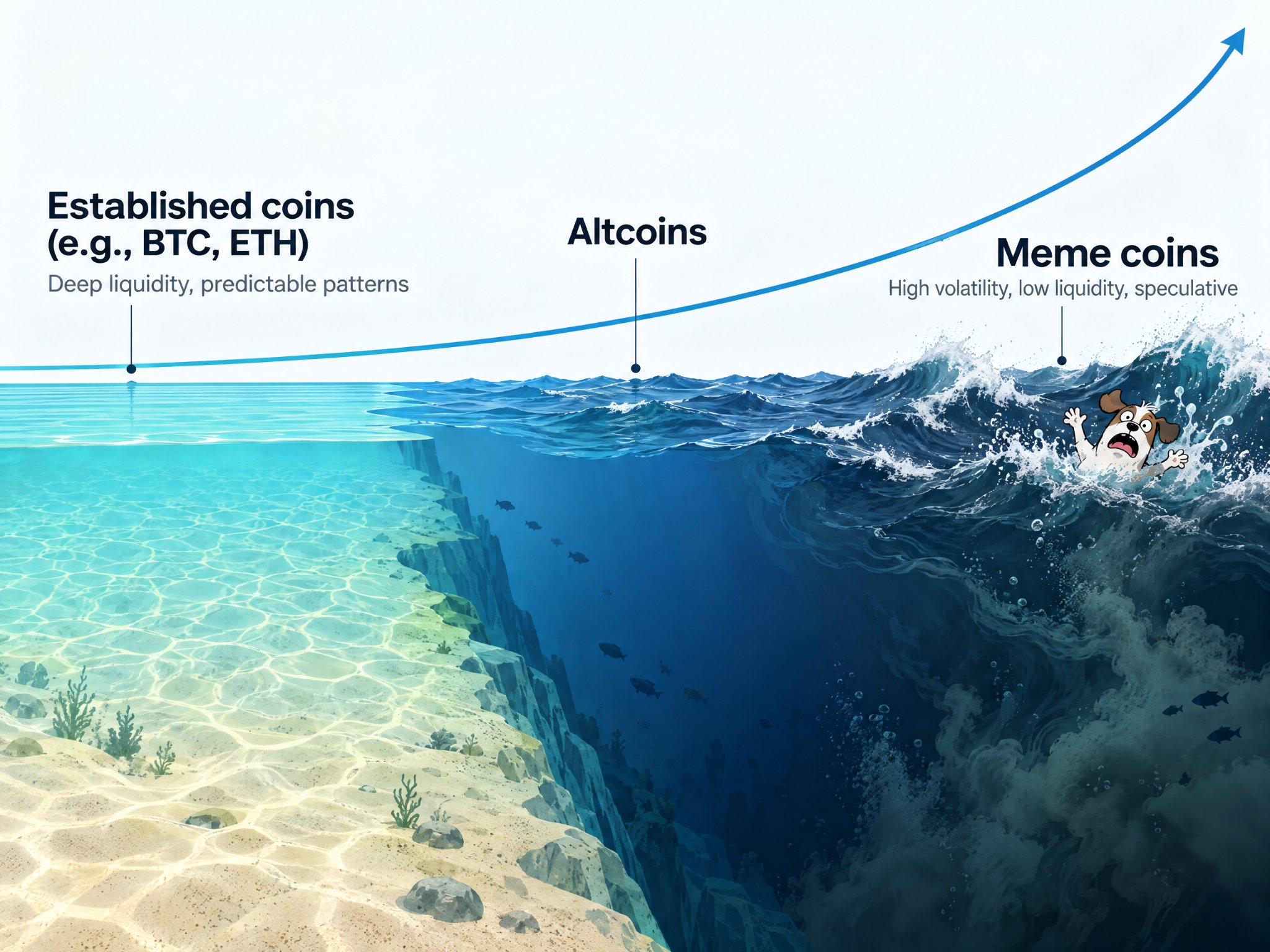
I'd start with the established coins. The big names have years of price history, deep liquidity and a lot of people watching them. That's the shallow end of the pool. Every step further out the risk curve, from large caps to altcoins to meme coins, the water gets deeper and murkier. Meme coins can do 500% in a week, and the same mechanics that make that possible make 90% drawdowns possible too. A coin named after a dog is not a retirement plan. It's a trade.
And whatever you trade, decide before you enter how much you're comfortable losing on it. If the answer is "all of it," size it like that. If the answer is "none of it," that's a sign too.
None of this is an argument against trading crypto. It's an argument for sizing for the market that exists, not the one you're used to. It will be Tuesday again soon.
This content is not intended for EU residents.
الأسئلة الشائعة
Correlation measures how closely two assets move in the same direction over time. A high correlation means Bitcoin and stocks have tended to rise and fall together, while a low one means they have moved independently. The link is unstable and can weaken for long stretches.
Some holders treat Bitcoin as protection against the falling value of paper currencies rather than as a growth bet. Its record is mixed, because in broad sell-offs such as March 2020 it fell alongside other risk assets.
A rising dollar often comes with expectations of higher US interest rates, which make holding dollar assets pay more. That makes assets with no yield, such as Bitcoin, relatively less attractive. The pattern has often held but is not guaranteed.
Usually far less. During the FTX collapse in November 2022, crypto fell sharply while broad stock markets did not suffer a comparable fall over the same days.